
How Valve sparked the SFF renaissance in the PC's dark ages
The SFF renaissance indicates the future of PC gaming will be about choice more than anything else.
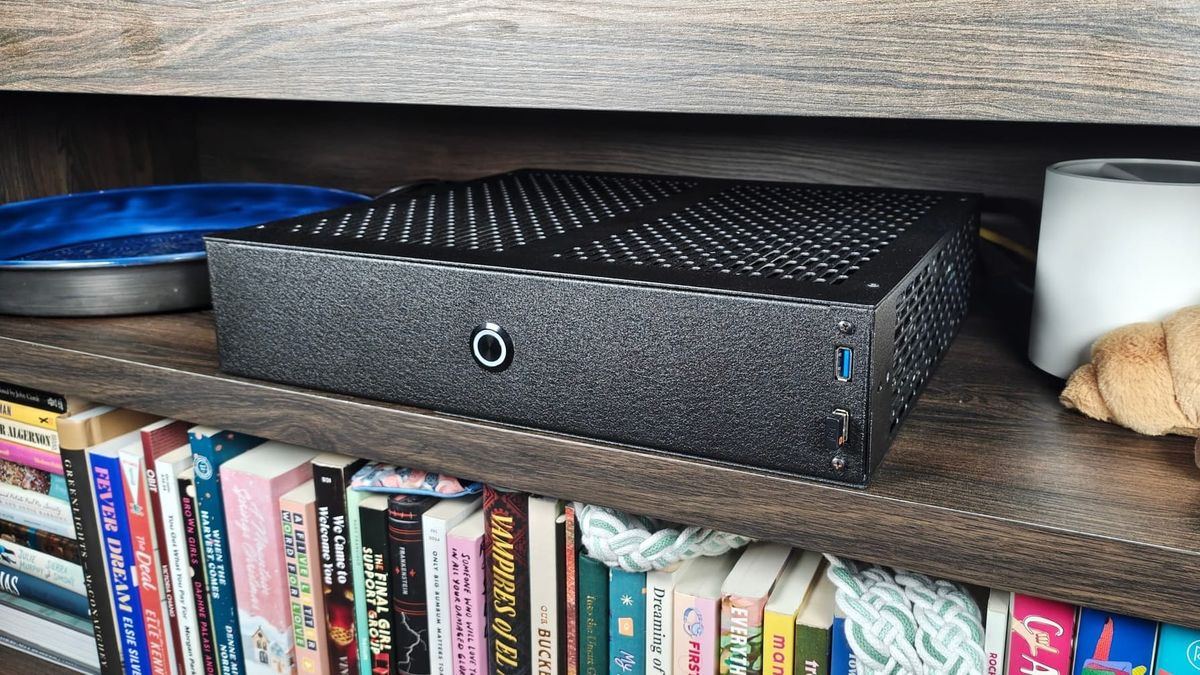
Like many at the time, I was someone interested in getting a Steam Machine after Valve first announced it (well, I guess this was the second time, but you get what I mean). And like many, this interest evaporated after Valve announced insanely high prices in the wake of the memory/storage crunch that started about a year ago. I expected the Steam Machine's legacy to be about pushing Linux gaming further. I could not have imagined the impact this PC would have on tiny computers, and I'm not exactly new to the concept.
About a decade ago, I built my first small form factor (SFF) desktop. I was still in high school, so I did it with a pretty small budget of about $400, which was just enough to get a dual-core G4560 (no Hyperthreading because Intel was stingy back then), some basic MSI B250I motherboard, a low-profile MSI RX 460 2GB, and 8GB of RAM. It wasn't much, but it performed pretty decently for the time, back when you could buy a brand-new gaming GPU for under $100.
This wasn't my main PC however, I didn't even need this desktop at all. Months prior, AMD launched its very first round of Ryzen CPUs, and I had picked up a Ryzen 1700 plus the new motherboard and RAM I needed, which paired nicely with the RX 480 I already owned. I built this gaming PC, which I thought was insanely small given the horsepower, just because I thought it would be really cool (and it was!). And just like that, I became a SFF enthusiast and kept building more PCs to be as compact as possible.
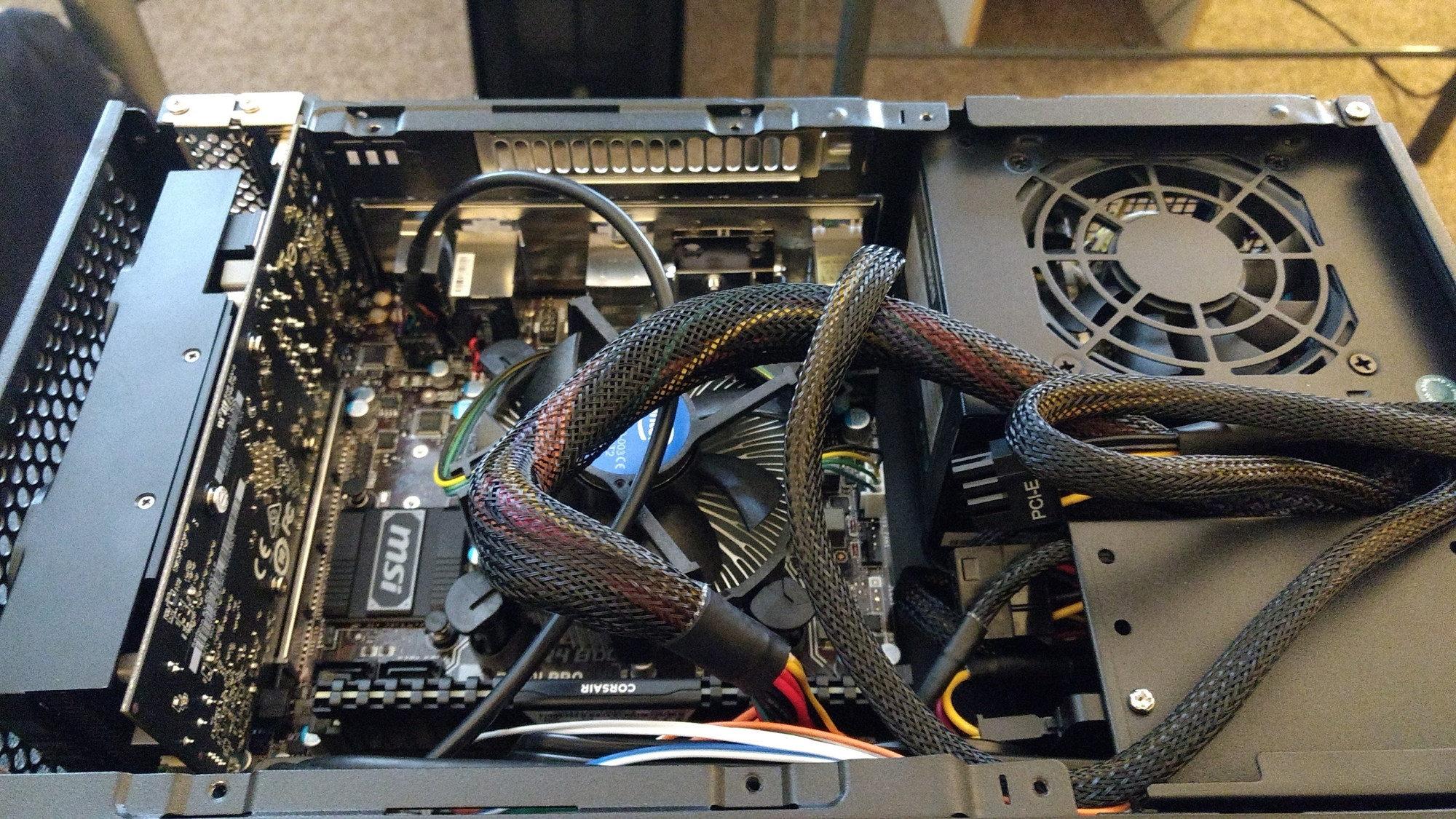
Fittingly, the SFF community has been small, due to a vicious circle. For most of the past decade, going SFF meant sacrificing performance. CPU coolers are much smaller with SFF builds (and especially back then weren't nearly as optimized as they are today) so that was a limitation on CPU performance, and there were very few SFF-friendly GPUs out there. The largest GPUs could, at best, be dual-slot and as long as the motherboard. For slim ITX cases, they also needed to be low-profile. Back when I built my first SFF PC, the fastest low-profile GPUs were the RX 460 and GTX 1050 Ti, and the fastest dual-slot ITX cards capped out at the RX 470 and GTX 1080 (though only Gigabyte made ITX models of anything faster than a 1060).
At the same time, these parts (GPUs, motherboards, coolers, even cases) were usually more expensive than the typical hardware despite the fact you were taking a performance hit, and probably had to tolerate louder fans to compensate for less cooling. Naturally, this did not attract users, so SFF remained a niche for the enthusiasts, who could and would pay higher prices because the alternative was not doing SFF, which wasn't an actual option, damnit. This was just the natural order of things; tiny PCs weren't for everyone.
Why the Steam Machine ignited the community's passion for SFF builds
And then the Steam Machine came and changed everything. I really do not think I'm exaggerating here, Valve really did single-handedly alter the landscape of SFF with just one computer, and it's been crazy to see tiny PCs go mainstream after all this time. While I'm not necessarily surprised SFF has gotten more attention because of the Steam Machine, I think the level of it is the interesting part, and that might be because the conditions for SFF are kind of perfect at the moment.
The SFF renaissance, as I'll call it, didn't come out of nowhere though. The Steam Machine set it off, but there's a few key trends in the past few years that set the stage for this to happen: the rise of Linux gaming with SteamOS and Bazzite, console-like features coming to HTPCs, and the way PC hardware has shaken out in respect to price and performance.
One of the most common reasons why people are interesting in going SFF, especially lately, is to build a HTPC that acts like a traditional gaming console, which is kind of the Steam Machine's reason to exist. At their core, PCs and consoles haven't really been that different (as of 2013, Playstation and Xbox even use AMD chips that are pretty similar to the retail stuff). For most people, the key differences are the hardware and software interfaces: keyboard and mouse versus controller, open operating system versus closed.
For a long time, the keyboard and mouse experience was the PC experience, the controller experience was the console experience. If you wanted a gaming-first operating system where it just worked from the first click, you went with a console, as going with a PC meant you had to click around on the Windows desktop, and if something went wrong, you had to fix it yourself. You could technically use a controller on PC, but how enjoyable that would be hinged on game support and third party software.
Today, the PC experience encompasses more than just clicking on the Steam icon in your taskbar, clicking the game you wanna play, and then clicking the launch button. First it was Steam Big Picture mode, then then it was SteamOS on the Steam Deck, and now it's SteamOS for AMD PCs or Bazzite for literally everything. Windows wasn't (and arguably still isn't) capable of enabling users to completely ditch the keyboard for everyday use; plus, Linux is the leaner OS with great support for games that were only ever made with Windows in mind.
Then there's a couple of crucial features associated with HDMI that were exclusive to consoles but are now coming to PC, with the Steam Machine paving the way. Firstly, there's CEC support, which for our purposes means when a CEC-compatible device turns on while connected to a CEC-compatible TV, the TV turns on and automatically switches the input to that device. Turn off the device, and the TV turns off too. The PS5, Xbox Series S/X, and Switch 2 all have CEC support.
CEC can be kinda annoying because there isn't always a ton of freedom in configuring exactly how it works, like maybe you want console power on to turn on the TV but not want console power down to turn off the TV, but it's still a pretty cool feature. But now it's available with HTPC too; pick up your Steam Controller, wake up your Steam Machine with it, and then the TV displays SteamOS, all with the single press of a button.
Now, a typical PC with a retail GPU is not able to do this because no desktop GPUs support CEC, but there are cable adapters that add in CEC, such as the UGreen 85564 which I own personally for my own Bazzite HTPC. The OS also needs to have some CEC functionality, which doesn't exist natively for Windows 11 but does in Bazzite. I'm able to replicate the Steam Machine's CEC functionality on my HTPC, though I will say that there were a couple of issues, one of them being needing to dig into the terminal and set up the ability to wake from my controller, and with Bazzite being an immutable OS this process was far from easy.
The other issue brings me to that other HDMI feature consoles have had and that PC now gets to have too: support for version 2.1. This is the thing that enables 4K resolution, 120 FPS, variable refresh rate (VRR), and high color depth all at the same time. With older versions of HDMI, you had to sacrifice some of these things, particularly VRR and color depth, so HDMI 2.1 is a pretty nice thing to have.
Now anyone familiar with HDMI 2.1 might find my description weird considering it's been supported by GPUs since 2020 and Windows 11 has perfect support for it; technically it's not new at all. However, it's different if we're talking about SFF PCs running Linux distros like Bazzite or SteamOS. Generally, gaming on Linux is best experienced with an AMD GPU, but the HDMI Forum blocked AMD's implementation of HDMI 2.1 for Linux, meaning no HDMI 2.1 for anyone running Linux. The best console-like PC experience is with Linux plus an AMD GPU (for now, anyways), so this has been a pretty big problem.
That was the case until earlier this year, anyways: HDMI 2.1 support was recently added to the Linux kernel and is now making its way downstream to different distros. Soon, anyone will be able to hook up a Bazzite-powered HTPC to a TV and run a game at 4K120 with VRR and HDR enabled. I will say though, that UGreen adapter I mentioned earlier is supposed to enable these features as well. Speaking from my own experience, I was able to get 4K and VRR working, but only up to 100Hz at a lower color depth, though some have said they got 120Hz and max color depth as well (some adapters may do a better job). I'm hoping some company will make an HDMI 2.1 cable with a CEC adapter so that I can get both CEC and HDMI 2.1 on my HTPC.
The last factor in the SFF craze is how hardware has evolved in the past few years. We used to have CPUs and GPUs ranging from $100 to $700 and low power/performance to high power/performance. Options were more limited and expensive for ITX-specific components, like motherboards, PSUs PCIe risers, cases, and coolers. If you were building an ITX PC, there was a significant premium and it could be beaten or matched by a much cheaper PC.
Today, it's very different. Because low-end GPUs simply don't exist anymore, you're forced into buying more premium cards starting at $250, even if you didn't really want one. RAM and storage are also more expensive, but other components have gotten cheaper, including ITX form-factor parts. The selection of ITX boards and PSUs is broader, cheaper, and better; PCIe risers got more popular outside of ITX so they're more of a commodity now; there's also more options for cases with more efficient use of space and the prices aren't too bad; and now Noctua isn't the only SFF CPU cooler company in town, with brands like Thermalright launching good coolers for very cheap.
Plus, the nature of the hardware has changed. The performance and efficiency gains with recent generations aren't as much as it used to be, overclocking just doesn't deliver the same kick it used to, and it's hard to justify using high graphics settings on modern games when low tends to look just fine too. You don't need the high performance, power guzzling components anymore; for CPUs specifically, getting the best gaming performance means getting one of AMD's X3D V-Cache chips, and those actually tend to have the lowest power consumption.
Into these circumstances, Valve launches this sexy PC that boasts some pretty cool hardware, except the price point is kinda bad. You might think to yourself, "this is the best Valve could do? I could do that but better and for less!" And that's exactly what a ton of people did. In my personal Reddit feed, I see posts about someone's homemade Steam Machine every day. Usually they use the Fractal Ridge or Fractal Terra or some similar case from Silverstone or another brand. I've seen lots of 3D-printed cases too, and that's also been a boon for SFF since even more space efficiency can be obtained with a custom case designed for specific parts.
Something like this couldn't have happened in 2019, even if we had Bazzite and HDMI 2.1 back then. SFF wasn't as attractive because there were alternatives like building for great value at a lower price point, or building for great performance at the same price point. Today, those alternatives don't really exist because the entry level price is much higher than it used to be, and climbing each rung of the ladder costs way more than it used to.
So if you're gonna spend all this money on a DIY PC, shouldn't it be cool and sleek? The cheapest dual-fan, dual-slot GPUs you can afford are already fine for a slightly larger ITX case, X3D CPUs are both fairly affordable and consume very little power, and SFF components don't really increase the budget, so why not try to make your own (better) version of the coolest PC in town? You can finally get the best of both worlds, a PC and console all in one!
PC makes the best of a bad situation by offering choice to its users
The way I see it, we're just trying to find the best parts of a very bad market. For years already, GPUs have been getting more expensive, more lacking on VRAM, and more incremental generation to generation. Within the last year, we've also seen soaring memory and storage prices. The excitement one could feel over building a PC with crazy good bang for buck is no longer possible to achieve, and building a top-end desktop now costs about 50 to 100% more than it did a couple of years ago.
But it's not all gloom. Gaming on Linux is better than ever, and enables some really unique experiences you wouldn't have been able to get until somewhat recently. Technologies like ray tracing and upscaling are finally maturing. Some components that used to be very premium are now pretty cheap, particularly ITX and SFF ones. Peripherals continue to get better and they're not priced too badly either.
If it weren't for the memory and storage crunch, I'd actually say this is one of the best times to build a PC since everything that doesn't include those parts has gotten cheaper; however, I do wonder if high prices for RAM, SSDs, and GPUs has depressed demand for all other PC components, leading to low prices being used to stimulate demand.
Regardless, there's also a much greater variety of components: SFF and ITX of course, but also cableless parts, good current- and last-gen CPUs from AMD and Intel, mainstream motherboards with features that used to be fairly premium, cases in all shapes and sizes, very accessible liquid AIO coolers, basically everything Framework makes, the list goes on.
For comparison, the console gaming community is also suffering from higher prices, but are getting essentially nothing in return for it. All consoles, every single model, are going up in price and in some cases receiving cuts to storage capacity; even games themselves are caught in the crossfire as prices rise and physical copies get rarer or are slated for obsolescence (Nintendo and Microsoft will likely follow Sony's lead here). No matter what platform you game on, things have gotten worse, but yikes it is far worse for console users.
This isn't a scree against console gaming (lifelong Nintendo fan here), but I find it incredibly ironic that many console gamers reacted to the Steam Machine's pricing with jokes about how Valve was shooting itself in the foot or extremely greedy for setting the minimum price at about a grand.
But while the Steam Machine is amazing, anyone can build their own (probably larger) take on the Steam Machine for less, using whatever parts they want and play whatever games they want. With consoles, users have no choice but to spend more if they want to game. It's really a great example of what the PC is great for, which in this case I guess is being far more resilient to global supply chain price increases on the most fundamental components of computers.
And looking towards the future, the SFF renaissance is emblematic of a big transition happening with PC gaming, where performance steps out of the spotlight and choice becomes the star of the show. I expect within a few years that it becomes increasingly common that builds use non-traditional parts such as 3D printed components, and run specialized Linux distros like Bazzite instead of Windows.
Maybe it's a bit of a leap to extrapolate all of that from people building small PCs, but I think it's hard to understate how big of a deal it is that someone can basically build a PC that genuinely competes with consoles on both form factor and user experience. Even five years ago doing all of this would have been hard to fathom, the closest we got back then was gutting an actual console and cramming PC components inside.
That's all to say, I'm very glad that the Steam Machine exists even though I will never buy one. While console-like PC builds have always been interesting to me, I didn't even know about CEC until the Steam Machine launched, and the convenience I got by adding it to my HTPC has really increased my interest in gaming, which has been waning for years. I've been pretty cynical about the state of PC for a few years now, but I'm kinda starting to feel like there's more to look forward to. From my perspective, that's the crux of the SFF renaissance.